

Telecom Equipment Market Set for Sustained Growth with a 6.82% CAGR Through 2035
Telecom Equipment Market
Telecom Equipment Market Size, Share and Research Report By Equipment Type (Radio Access Network, Optical Transport, Core Network Equipment)
Telecom Equipment Market: Telecom equipment forms the backbone of modern communication networks by supporting high-speed data transmission and expanding global connectivity.”
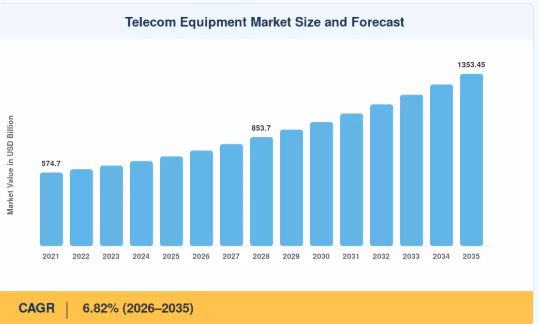
SEOUL, SEOUL, SOUTH KOREA, July 29, 2026 /EINPresswire.com/ -- The Global Telecom Equipment market stood at an estimated USD 700.48 billion in 2025 and is projected to open the forecast window at roughly USD 748.27 billion in 2026, climbing to USD 1,353.45 billion by 2035 at a CAGR of 6.82%. Two forces anchor this trajectory: 5G standalone network commercialization pushing operators toward cloud-native core and radio refresh cycles, and government broadband stimulus programs channeling guaranteed procurement into fiber access and fixed-wireless equipment both of which push telecom equipment from discretionary capex to non-negotiable infrastructure spend. — Market Research Future (MRFR)
The market's 6.82% CAGR reflects the convergence of 5G SA network commercialization (~1.8% CAGR impact), government broadband stimulus programs (~1.4%), AI and ML workload growth in data centers (~1.2%), fiber-to-the-home expansion in emerging economies (~0.9%), and enterprise private 5G adoption (~0.7%) accelerating across the world's largest carrier and hyperscaler markets simultaneously.
Legacy distributed 4G architectures and discrete optical transponders are increasingly being replaced by cloud-native, containerized 5G standalone cores and coherent pluggable optics that consolidate intelligence and bandwidth into leaner, software-defined platforms. Investment in disaggregated and virtualized radio architectures is increasingly focused on vendor diversification over single-supplier lock-in, reducing procurement risk and total cost of ownership.
North America dominates the market with an estimated 41.5% share, driven by aggressive mid-band spectrum deployments and hyperscaler edge partnerships. Asia-Pacific is the fastest-expanding region as India, Southeast Asia, and Japan accelerate greenfield 5G and fixed-wireless rollouts. Not far behind is Europe, with sovereign-network mandates and subsea cable landing investments across the continent. Telecom equipment is becoming a fundamental national-infrastructure need rather than a purely commercial differentiator as carriers race to retire legacy assets and scale next-generation capacity.
Get Full PDF Sample Copy of Report: (Including Full TOC, List of Tables & Figures, Chart) @
https://www.marketresearchfuture.com/sample_request/4441
➤ How Significant Is the Telecom Equipment Market's Growth?
The telecom equipment market's trajectory from USD 700.48 billion in 2025 to a projected USD 1,353.45 billion by 2035 represents nearly a doubling over the forecast decade, reflecting the structural shift across global carrier networks from distributed 4G architectures and discrete transport hardware toward cloud-native 5G standalone cores and coherent pluggable optics as a baseline infrastructure standard. The market's 6.82% CAGR is anchored in a network-modernization supercycle where hyperscaler data-center interconnect demand, government-funded rural broadband buildouts, and enterprise private 5G deployments are all specifying next-generation equipment as a non-negotiable procurement requirement.
Radio Access Network equipment accounts for an estimated 35.5% of 2025 revenue, remaining the default line item for urban densification and small-cell deployment, while Optical Transport equipment is forecast to grow at a 10.1% CAGR through 2035 as data-center interconnect demand accelerates. 4G/LTE platforms represent roughly 42.4% of total 2025 demand the largest single technology-generation segment while 5G (NSA + SA) equipment is advancing at a 21.9% CAGR, the fastest of any generation. Telecom operators remain the largest end-user category at 76.0% share, driven by nationwide 5G coverage obligations, while Enterprise (Private 5G) is growing at 15.7% CAGR. By component, Hardware is valued at USD 217.16 billion in 2025, followed by Software at 59.2% share, with Services posting the fastest component CAGR at 20.9% through 2035.
➤ What Does the Future Hold for the Telecom Equipment Market?
5G standalone network commercialization contributes approximately 1.8 percentage points to the telecom equipment market's CAGR the single highest driver impact. Operators across 45 countries had launched or committed to 5G SA cores by mid-2025, and chipset vendors shipped over 380 million 5G-capable modem units in 2024 alone. SA architecture unlocks network-slicing revenue that justifies the radio and core equipment refresh cycle, exemplified by a USD 14 billion multi-year network modernization contract awarded to a leading North American operator the largest single telecom equipment award announced in 2024.
Government broadband stimulus programs contribute approximately 1.4 percentage points to the CAGR, establishing regulator-backed procurement as a primary, funding-anchored demand source. The U.S. BEAD program began disbursing its USD 42.45 billion allocation in 2025, while the EU's Recovery and Resilience Facility channels EUR 130 billion toward digital infrastructure. This shift is most pronounced in regions with dense rural and underserved geographies, where fiber access and fixed-wireless platforms are being specified with guaranteed procurement floors that private-sector capex alone cannot replicate. AI and ML workload growth in data centers contributes a further 1.2 percentage points to the CAGR, as hyperscalers committed over USD 160 billion in combined 2025 capex guidance that disproportionately benefits optical transport and high-speed switching vendors.
The next product generation is shifting from bolt-on orchestration layers to inference accelerators embedded directly into radio and transport hardware, allowing equipment to run autonomous network operations without external compute. Vendors are increasingly competing on platform economics and API monetization fleet management dashboards, network-as-a-service revenue models, and programmable network platforms rather than hardware specifications alone. Carriers are standardizing on disaggregated radio architectures that separate baseband processing from the radio unit, reducing vendor lock-in while streaming aggregated network telemetry to centralized operations centers. Vendors that successfully compress AI inference models for low-power radio and transport hardware can differentiate on autonomous operations without requiring carriers to add external compute a capability still unevenly distributed across the competitive set and representing one of the market's most powerful near-term performance differentiation opportunities.
Get access to the full description of the report @
https://www.marketresearchfuture.com/reports/telecom-equipment-market-4441
➤ Who Are the Key Players in the Telecom Equipment Market?
The telecom equipment market is moderately consolidated, with the combined share of the top five estimated at 55–65% and three global-scale incumbents competing alongside a broadening tail of specialist and regional players a structure consistent with a market still defined by geopolitically reshuffled procurement patterns rather than commoditized hardware. MRFR identifies the following key participants with estimated revenue share ranges:
✿ Huawei Technologies (~18–22% share) – the global-scale, end-to-end portfolio leader providing RAN, optical, core, and enterprise solutions, with the broadest deployed base of telecom infrastructure globally and dominant positioning across Asia-Pacific and emerging markets.
✿ Ericsson (~14–18% share) – a North America and Europe-preferred vendor providing 5G RAN, cloud-native core, and managed services, anchored by a USD 14 billion multi-year network modernization contract that underscores its role in the standalone-core transition.
✿ Nokia Corporation (~12–16% share) – a broad-portfolio specialist providing radio, fixed access, IP routing, and optical transport, with the March 2025 AirScale 5G-Advanced massive-MIMO radio portfolio enabling 64T64R antenna configurations across Europe and Asia-Pacific.
✿ ZTE Corporation (~7–10% share) – a cost-competitive positioning specialist providing RAN, optical, and core equipment, with growing share across Asia, the Middle East & Africa, and Latin America.
✿ Samsung Electronics (~5–8% share) – a rapid North American expansion leader providing 5G vRAN and network solutions, leveraging virtualized RAN leadership to serve U.S. and Korean carrier deployments.
✿ Cisco Systems (~4–6% share) – an enterprise and data-center crossover specialist providing routing, switching, optical, and SD-WAN solutions for telecom and hyperscaler customers alike.
✿ Ciena Corporation (~3–5% share) – an optical transport specialist providing coherent platforms built on WaveLogic technology, with November 2024 volume shipments of its WaveLogic 6 Extreme 800G coherent pluggable modules achieving record spectral efficiency for data-center interconnect.
✿ CommScope (~2–4% share) – an in-building and venue connectivity leader providing antenna systems, fiber connectivity, and distributed antenna systems for dense urban and indoor deployments.
✿ Juniper Networks (~2–3% share) – a data-center and cloud-provider focus specialist providing AI-driven routing and switching platforms for carrier and hyperscaler network cores.
✿ NEC Corporation (~2–3% share) – a niche-strength provider of disaggregated RAN and submarine cable systems, with particular depth in Japan and open-architecture platform deployments.
Strategic competition in the telecom equipment market is increasingly defined by AI-inference embedding and disaggregated-radio compatibility, with geopolitical vendor restrictions cited as a top procurement constraint alongside Open RAN interoperability, energy-efficiency performance in RFP scoring, and the depth of network-as-a-service platforms that convert one-time hardware sales into recurring software and API revenue.
➤ What Are the Emerging Trends in the Telecom Equipment Market?
Several transformational trends are redefining the telecom equipment market's evolution through 2035:
AI-Native Network Operations and Autonomous RAN Management: Leading operators are moving toward autonomous network operations centers where AI agents manage capacity planning, fault resolution, and energy optimization in real time. Equipment vendors that embed inference accelerators directly into radio and transport hardware are establishing AI-native performance as the new competitive baseline for premium network operations.
Disaggregated and Virtualized Radio Architectures (Open RAN): Operators are trialing disaggregated radio solutions that isolate baseband processing from the radio unit in pursuit of vendor diversification and capex flexibility. Early demand from Rakuten Symphony and Vodafone signals an addressable equipment base that could reach USD 18 billion by 2030.
Platform Economics and API Monetization: Carriers are increasingly monetizing network capabilities through API exposure platforms, enabling enterprises to purchase slicing, quality-of-service guarantees, and edge-compute resources on demand. This shift converts one-time equipment sales into recurring managed-service revenue, with the GSMA's Open Gateway initiative now backed by operators representing 70% of global mobile connections.
5G Standalone Core Commercialization and Network Slicing: SA deployments unlock ultra-reliable low-latency communication and edge-compute hosting that justify premium equipment pricing. With chipset vendors shipping over 380 million 5G-capable modem units in 2024, standalone-core equipment remains the principal growth engine for the market through 2035.
Energy Efficiency and Sustainability Mandates: The ITU's Green Digital Action Track targets a 45% reduction in ICT-sector carbon intensity by 2030. Equipment vendors are responding with liquid-cooled radio units, energy-harvesting small cells, and sleep-mode algorithms that cut site power consumption by 25–40%, with sustainability performance now a weighted criterion in operator RFPs.
Non-Terrestrial Network Integration and Early 6G R&D: Low-earth-orbit satellite constellations are converging with terrestrial 5G networks under 3GPP Release 17 and 18 standards that codify satellite-as-a-cell backhaul, opening an estimated USD 12 billion incremental opportunity by 2033, even as vendors begin early R&D toward a 6G standards freeze anticipated around 2030.
Buy Full Research Report:
https://www.marketresearchfuture.com/checkout?currency=one_user-USD&report_id=4441
➤ How Is the Telecom Equipment Market Segmented?
The telecom equipment market report provides a comprehensive segmentation framework:
By Equipment Type: Radio Access Network, Optical Transport, Core Network Equipment, Customer Premises Equipment, Other Equipment
By Technology Generation: 2G/3G (USD 28.02B, 2025), 4G/LTE (42.4% share, 2025), 5G NSA + SA (21.9% CAGR, fastest), Other/Pre-standard (3.2% share)
By Component: Hardware (USD 217.16B, 2025), Software (59.2% share, 2025), Services (20.9% CAGR, fastest)
By End-User: Telecom Operators (76.0% share), Neutral-Host and TowerCos (USD 63.04B), Enterprise/Private 5G (15.7% CAGR), Government and Defense (5.3% share)
By Region: North America (41.5%), Europe (~24.0%), Asia-Pacific (21.8% CAGR), South America (USD 31.52B), Middle East & Africa (8.6% CAGR)
➤ What Are the Regional Insights from the Telecom Equipment Market?
North America leads the telecom equipment market with a 41.5% share in 2025, with the United States commanding 82.3% of regional revenue through BEAD disbursements and C-band densification. US federal broadband funding and aggressive mid-band spectrum deployment by the three national carriers is the single largest regional growth contributor, with new fiber and fixed-wireless buildouts specifying next-generation equipment as a baseline requirement rather than an add-on. Canada contributes a meaningful share of regional revenue through CRTC rural broadband mandates channeling CAD 3.2 billion into fiber and fixed-wireless projects, and Mexico grows at 7.9% CAGR through IFT spectrum liberalization and nearshoring-driven industrial connectivity needs.
Asia-Pacific holds a substantial and fast-growing share of global telecom equipment market revenue in 2025 and represents the fastest-growing region at a 21.8% CAGR, anchored by China's 39.4% regional share through state-led 5G-Advanced rollout and pre-6G pilots. India contributes the fastest country-level CAGR in the region at 24.3%, supported by BharatNet Phase III and Jio and Airtel 5G expansion that crossed 200 million connections by Q1 2025. Japan contributes regional share through the NTT IOWN photonic networking initiative, South Korea through 28 GHz mmWave enterprise deployments, and ASEAN grows at 19.5% CAGR as 5G licensing accelerates across the Philippines, Vietnam, and Thailand.
Europe accounts for approximately 24.0% of global telecom equipment market share, with Germany commanding 27.8% of regional revenue through campus-network licensing and the Gigabit Strategy 2030 program that has made Gigabit connectivity a common line item in EU cohesion-fund broadband projects. The United Kingdom contributes regional share through the Project Gigabit fiber rollout, France grows at 6.5% CAGR through the France 2030 digital sovereignty plan, Italy contributes 9.2% of regional share through PNRR-funded fiber deployment, and Spain and the Nordic countries add further share through 5G spectrum awards and sustainability-driven network modernization. Geopolitical vendor restrictions continue to reshape European procurement, elevating Nordic and Korean suppliers while raising average equipment prices across affected procurement cycles.
South America and the Middle East & Africa each represent a smaller but structurally growing share of global telecom equipment market revenue, with distinct demand profiles. Brazil commands 62.5% of South American revenue through Anatel's 3.5 GHz coverage obligations compelling nationwide 5G infrastructure deployment by 2028, with Argentina's ENACOM spectrum refarming adding 7.2% CAGR of regional growth. Saudi Arabia holds 31.2% of MEA revenue through the NEOM smart-city gigaproject, the UAE grows through 5G-enabled logistics and tourism corridors, South Africa expands at 9.4% CAGR through ICASA spectrum assignment and digital-inclusion programs, and Egypt adds regional share through NTRA fiber backbone expansion. Gulf state and sub-Saharan African programs remain earlier in their adoption curve than other regions but represent a structurally growing long-term frontier for telecom equipment market expansion through 2035.
➤➤➤ Industry Analysis Reports by Market Research Future:
Circular Waterproof Connector Market
https://www.marketresearchfuture.com/reports/circular-waterproof-connector-market-38515
Bidirectional Battery Switch Market
https://www.marketresearchfuture.com/reports/bidirectional-battery-switch-market-38540
Discrete Capacitor Market
https://www.marketresearchfuture.com/reports/discrete-capacitor-market-38546
Electromagnetic Compatibility Filtration Market
https://www.marketresearchfuture.com/reports/electromagnetic-compatibility-filtration-market-38561
Electronic Pressure Transmitter Transducer Market
https://www.marketresearchfuture.com/reports/electronic-pressure-transmitter-transducer-market-38579
Pm2 5 Sensor Market
https://www.marketresearchfuture.com/reports/pm2-5-sensor-market-38590
Underwater Sensor Market
https://www.marketresearchfuture.com/reports/underwater-sensor-market-38666
Internet Of Things Iot In Bfsi Market
https://www.marketresearchfuture.com/reports/internet-of-things-in-bfsi-market-39115
Human Identity Chips Market
https://www.marketresearchfuture.com/reports/human-identity-chips-market-39152
Level Measuring Equipment Market
https://www.marketresearchfuture.com/reports/level-measuring-equipment-market-40104
Sagar Kadam
Market Research Future
+ + +1 628-258-0071
email us here
Legal Disclaimer:
EIN Presswire provides this news content "as is" without warranty of any kind. We do not accept any responsibility or liability for the accuracy, content, images, videos, licenses, completeness, legality, or reliability of the information contained in this article. If you have any complaints or copyright issues related to this article, kindly contact the author above.
